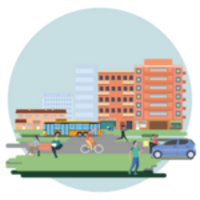
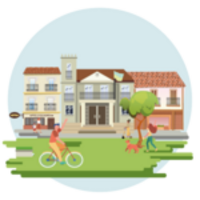
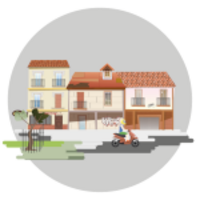
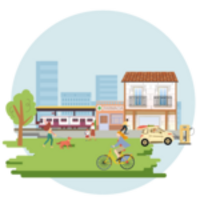
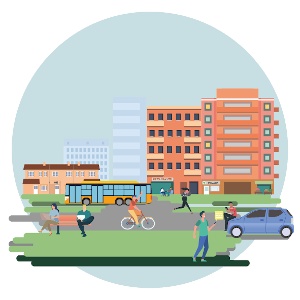
Scenario 1
Trend
- Intense urban growth
- Low land-use and activity mix
- Growth of the periphery
- Extensive network of green corridors
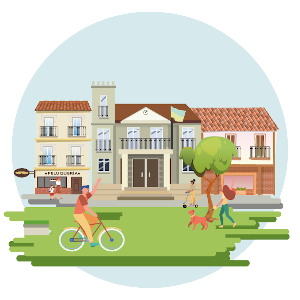
Scenario 2
Non-motorized urban centers
- High land-use and activity mix
- Pedestrianization of the city center
- Walking and cycling trips
- Extensive network of green corridors
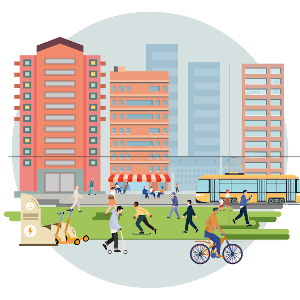
Scenario 3
Overpopulation
- Intense urban growth
- High land-use and activity mix
- Walking, cycling, and public transportation trips
- Extensive network of green corridors
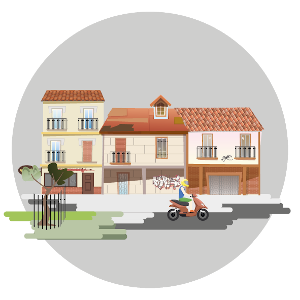
Scenario 4
High levels of public insecurity
- Social segregation
- Low land-use and activity mix
- Private vehicle trips
- Complete lack of green corridors
Scenario 5
Sustainability
- Moderate urban growth
- High land-use and activity mix
- Walking and cycling trips
- Extensive network of green corridors
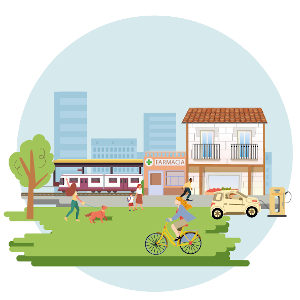
Below is a description of the main spatial characteristics that distinguish each of the scenarios and that will affect the spatial outcome of each simulation.
Urbanization process:
Increase in cities and their population, as well as in the functions carried out within them. It involves a transformation and expansion of the traditional urban space towards the periphery.
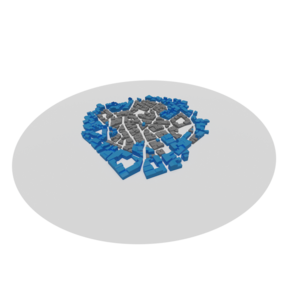 Low growth
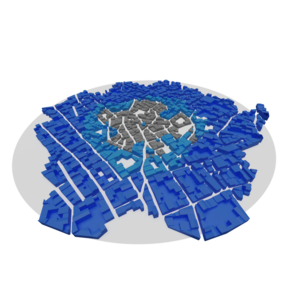 High growth
Degree of urban sprawl:
Compact: A type of settlement that is dense, continuous, with diverse urban activities and uses that are close to each other, surrounded by agricultural, natural spaces, etc.
Sparse: A type of settlement that is low-density, occupying large areas of land in a discontinuous manner, increasing the distance between residential areas and places of work, educational, healthcare, leisure centers, etc., which are concentrated in the central areas of the city.
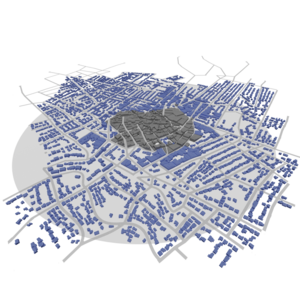 Dispersion
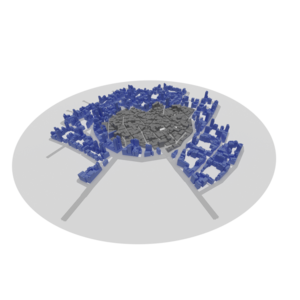 Compaction
Degree of urban diversity:
Urban diversity is defined as the characteristic of having urban spaces with different combinations of land uses and activities that allow for a socially and culturally vibrant environment, thereby improving the quality of life for citizens.
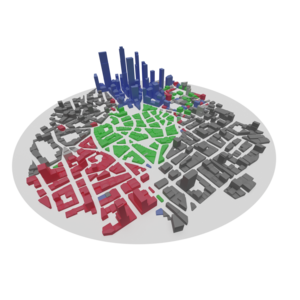 Segregation
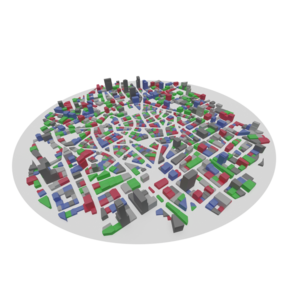 Mixture
Green corridors presence:
A green corridor is defined as those elements of the landscape that connect multiple spaces of an ecological, social, cultural, or any other nature compatible with sustainable land use.
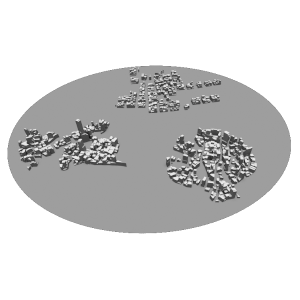 No presence of green corridors
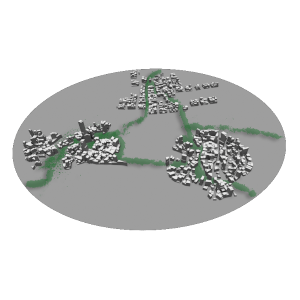 High presence of green corridors